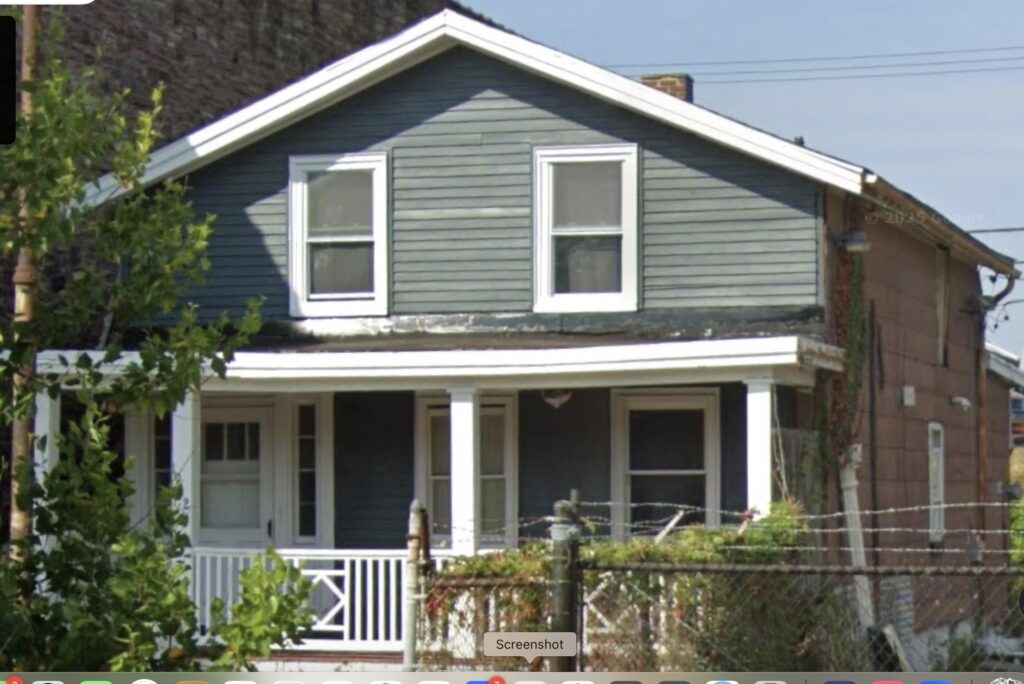
The Blossom Homestead at 1942 Niagara Street is part of the recently designated Lower Black Rock Historic District and is a rare survivor from the early period of settlement at Lower Black Rock. The house was built circa 1836 by Samuel Blossom (1791-1840) in the Greek Revival style and retains the original exterior millwork including a fine door surround with sidelights and pilasters. The house was built with a timber frame supported by wide vertical planks sheathed in clapboards, a common method of construction prior to the Civil War.
Samuel Blossom came from Monmouth Maine to Black Rock in 1836 and was met by his brother Ira Blossom, Ira was an assistant to Joseph Ellicott and a Subagent for the Holland Land Company. Samuel and Ira were “progressives” and had a reputation for being very liberal in providing credit to those just starting out, many businessmen would credit the brothers with their eventual success.
Jane Hillman (1796-1877) was wooed and wed by Samuel and came as a bride by packet boat to Black Rock on the Erie Canal from Monmouth “way down east in Maine” Three children would be born to the Blossoms in their new home before Samuel’s death in 1840. Grant Street in Black Rock was originally named Blossom Street in honor of Samuel.
A newspaper article from 1917 provides an excellent summary of the homestead’s history stating “Taking up a homestead at the Lower Rock, or North Buffalo on the west side of Niagara Street, 66 feet front, between Austin and Hamilton, running down to the Erie Canal, S.F. Blossom built a roomy house typical of the period, numbered 1942, this historic home is one of the last still standing at the Lower Rock.”
The 1853 City Directory, the first to include the former independent village of Black Rock after it was annexed by Buffalo, lists Jane Blossom as the widow of Samuel Blossom residing on the parcel. The Census of 1855 identifies Jane Blossom as head of household, age 59 residing on the property. The Blossom family descendants would continue to occupy the homestead until 1904 when the property was sold to the North Buffalo Lodge for the purpose of erecting the Unity Temple and the house was converted into a caretaker’s cottage. The maps from 1856 to 1950 reveal the house was always sited on the north side of the parcel but was moved back in 1905 to accommodate the construction of the Unity Temple and moved forward in 1957 to accommodate the construction of the New York State Thruway.
When the developers of Unity Temple and Jubilee Library project sought to demolish the Blossom Homestead, an effort began to protect this historic home and “blossomed” into a larger effort to protect the historic streetscape on the west side of Niagara Street. The end result was the establishment of the Lower Black Rock Historic District that includes 12 buildings dating from 1830 to 1915 as the only remaining Erie Canal era streetscape remaining in the City of Buffalo.